Showing posts with label Thriller Index. Show all posts

Sunday, October 30, 2011

Sep E. Scott - reused covers part 2

Continuing our look at the reprinted Robin Hood cover art by Sep E. Scott. The original Thriller versions of these images can be found in our index, The Thriller Libraries.

Buster Adventure Library 22 (reprints TPL 222)

Buster Adventure Library 24 (reprints TPL 202)

Buster Adventure Library 26 (reprints TPL 186)

Buster Adventure Library 28 (reprints Robin Hood Annual 1958)

Buster Adventure Library 32 (reprints TPL 182)

Buster Adventure Library 36 (reprints TPL 170)

(* My thanks to Roger Green for providing the original scans.)

Thursday, September 1, 2011

Sep E. Scott - reused covers

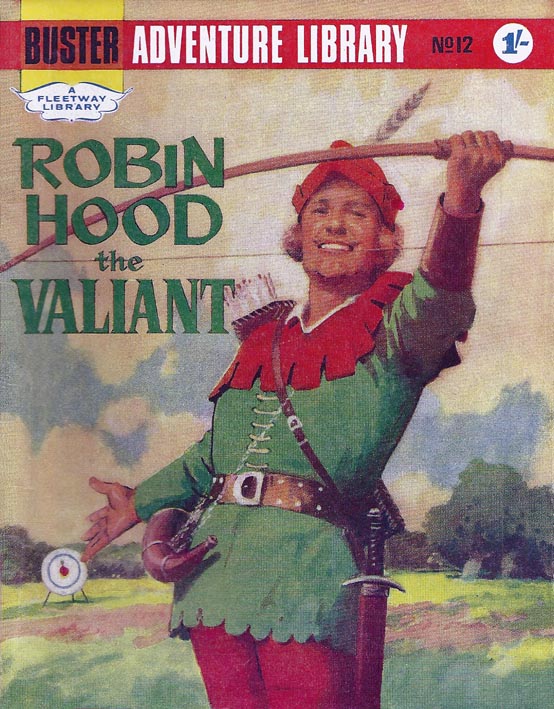
Sep E. Scott was one of the finest artists used by Thriller Picture Library and it is no surprise that his work - much of it on the Robin Hood series - was reprinted. We published a complete run of Thriller covers in The Thriller Libraries index, so we have some reprints from Buster Adventure Library here for you delectation and delight.

Buster Adventure Library 4 (reprints TPL 198)

Buster Adventure Library 10 (reprints TPL 77)

Buster Adventure Library 12 (reprints Robin Hood Annual 1958)

Buster Adventure Library 14 (reprints TPL 236)

Buster Adventure Library 18 (reprints TPL 106)

Buster Adventure Library 20 (reprints TPL 166)

Wednesday, August 31, 2011

Cowboy cover reprints

In The Thriller Libraries we were able to index the mysterious and very scarce Australian cowboy comics for the very first time. These comic book titles were published by the Amalgamated Press, written, drawn and edited in the UK for exclusive printing in Australia in an attempt to recapture some of the market the A.P. had lost during and immediately after the war. Many of the stories were subsequently reprinted in Cowboy Comics, the first British comic pocket library.

A great many covers were also reused by Cowboy Comics but with variations. Take, for instance, Kit Carson issue 17, published in April 1951; the same cover was used on Cowboy Comics issue 30 in June 1951 but with coloured in an entirely different way to take advantage - I believe - of the better printing process used on the British Cowboy Comics.

The cover artist was Geoff Campion, who would have supplied a black & white image in the first instance; the colour separations were handled by someone else, probably Kay Ivens who was, at one time, Edward Holmes' secretary - Holmes being the editor of both the Australian A.P. comics and Cowboy Comics. Kay Ivens later left comics to become a nurse, but what happened to her after that is unknown.

Geoff Campion, a master of dynamic action scenes, clearly thought he'd captured a moment in this scene and reused roughly the same image for a Billy the Kid cover story in Sun in 1952.

(* Artwork © IPC Media)

Sunday, July 31, 2011

The Thriller Libraries: corrections and additions

In a book the size of The Thriller Libraries, a number of errors are almost certain to creep in and, the moment you complete the book, new information is bound to come to light. I'm pleased to say that the number of errors spotted has been minimal, but it is worth setting up a column so that when anything turns up, there will be somewhere to post the information.

p.21. The picture labelled Cowboy Picture Library 346 is, in fact, Western Library 59 (see image at the top of this column). The artist is James E. McConnell.

p.25. The caption "Cecil Doughty's bright and dynamic original painting of Dick Turpin for the cover of Thriller Picture Library 223" should read "Stephen Chapman's bright and dynamic...". Chapman is correctly credited with the cover on p.175.

p.118. The artist credit for Cowboy Picture Library 387 should be Jorge Moliterni rather than Jorge Macabich. This alteration should also be noted in the artist's index on pages 272 and 273.

p.245. The scriptwriting credits for issues 137 and 139 have been mixed up. 137 is by Harry Harrison and 139 is by Conrad Frost/Barry Coker.

p.275. Unknown Artist [B] has been identified as Emilio Frejo. Frejo is, therefore, the artist of issues 455 (p.124) and 467 (p.125) of Cowboy Picture Library.

Thursday, June 30, 2011

Thriller Index bonus

Above is an original painting that we didn't have room for in The Thriller Index. The artist is Giorgio De Gaspari, one of the regular cover artists on Cowboy Picture Library between September 1958 and May 1960. Infamously, De Gaspari was asked to produce a Kit Carson cover featuring Kit by a rock in the desert with a sandy background. Rather than paint one in, De Gaspari sent his wife to the seaside by taxi to collect buckets of sand; this involved a major round-trip as Milan, where he was based, was nowhere near the ocean.

When the artwork arrived, the editors marvelled at the artist's genius... then peeled off the real sand that he had glued to the page as the machinery involved in the printing process would not have taken kindly to bits of sand falling off the artwork.

I have my suspicions that the artwork in question was either the piece above, from issue 321, September 1959, or issue 325 (October 1959), both of which have sandy backgrounds.

Monday, February 28, 2011

Arnold Beauvais

One of the names that crops up regularly in our upcoming Thriller Index is that of Arnold Beauvais. He was the main artist for Super Detective Library, contributing from almost the beginning—his first cover appearing on issue 7 (July 1953) and his last on issue 112 (September 1957). In all he produced 89 covers for Super Detective, almost half the total for that paper's 188 issue-run and included an uninterrupted run between issues 14 and 49 (October 1953 to March 1955).

Sadly, it seems that none of his covers have survived the years and we could find no examples of original artwork to include in The Thriller Index. To redress the balance a little, as his work on Super Detective Library certainly deserves some recognition, here's a little background on Beauvais, illustrated with some of his covers.

Arnold Victor Beauvais was the third child of Charles Henri Beauvais, a talented painter born in Marseille in 1860 or 1861 (not 1864 as some record). After training in Paris, Charles came to England where,  in 1882, he married Emily Annie Corfield in Dartford, Kent. Charles and Annie went on to have six children: Daisy (1882-1980), Raoul Ernest Jules (1884- ), Arnold Victor, Reginald Louis (1888-1921), Charles Frederick (1895-1960) and Delphine Henriette (1905-1991). Charles certainly encouraged his children's artistic talents: Daisy was listed as an artist (sculpture) in census records and Charles Frederick Beauvais became an industrial designer, working in the car industry in England and Australia before setting up his own company.

The Beauvais family was raised in Lewisham and Streatham, their father working as an artist and lithographer from home. Arnold, born in Catford on 13 April 1886, began working in his father's studio at the age of 14 whilst studying art during the evenings at Bolt Court Art School, Fleet Street.

In 1903, Charles returned to France, taking his whole family with him. In Marseilles he opened a commercial art studio. Arnold, meanwhile, spent sixteen months studying in Paris before joining his father's studio.

Charles died in Marseilles in 1909, aged only 48 (some sources say 1911), and Arnold took over the management of the studio for the next few years. He returned to England in 1913, renting a studio in Chancery Lane, and produced artwork for a wide range of clients, including J. Lyons, R.K.O. Radio Pictures, Black & White Whisky, Warner Bros., Walt Disney Co., Youngers Scotch Ales and many others. His illustrations and cartoons appeared in adverts, on film posters, in magazines and on jigsaw puzzles.

His most famous advertising campaign was probably the 'Where's George?—Gone to Lyonch' campaign for Lyons' Teashops in the mid- to late-1930s. The catchphrase caught on and was often used wherever anyone was missing; it even inspired a film starring comedian Sydney Howard which, lacking a character called George, is better known nowadays as Hope of his Side (1935).

Beauvais was so successful in his career that it allowed him not only to paint for pleasure but to indulge in his other hobby, singing. He made his debut as the King in Prince Ferelon; or, The Princess's Suitors at the Florence Etinger School of Opera in November 1919 and then played Sarastro in The Magic Flute at the Old Vic (1920); his other appearances at the Old Vic included Ferrando in Il Trovatore (1922?), King Mark in Tristan and Isolde (1923), the King in Fete Galante (1924) and Aida (1925) and a soldier in Carmen for the Old Vic's reopening in 1928, as well as appearing in Figaro later that year. Beauvais also performed in Don Giovanni at the Coliseum (1924) and in performances of Rigaletto, Lohengrin, Faust and others. Beauvais also designed a famous poster in 1921 when the Old Vic, in Waterloo Road, London, appealed for £30,000 in donations to bring the theatre up to safety regulations.

He also sang on the radio in its early days of broadcasting from Savoy Hill and made several recordings for Columbia.

The work he produced for film distribution companies included posters for many famous films, including The Hunchback of Notre Dame, Swiss Family Robinson, Ip in Arms and all the subsequent Danny Kaye films. He regularly painted posters for Walt Disney, including Snow White, Bambi, Treasure Island, Robin Hood, Alice in Wonderland, Hans Anderson, Peter Pan and a host of Disney's nature films. The success of the films meant that this work was often used to illustrate the associated "book of the film" titles that were produced by Colllins.

His involvement with the film world began in the mid-1930s and lasted for two decades, during which time he also produced a highly successful series of caricatures of famous film stars for the magazine Film Weekly, using an air-brush technique that was little used at the time.

Beauvais was also teacher at the Bolt Court Art School, his old alma mater, in the 1930s. He was also a member of the London Sketch Club from 1929; he was elected President in 1936 and was subsequently a Life Member.

His association with Super Detective Library slowed down from 1956, in which year Beauvais reduced his commercial commitments in order to concentrate on oil paintings. In around 1959, he began colouring a two-page spread in the nursery comic Jack and Jill which was drawn primarily by Walter Booth; the spread, entitled 'There Was an Old Woman who Lived in a Shoe' depicted various scenes of what the children got up to; Beauvais took over the strip in 1960 when it was renamed 'The Children Who Lived in the Shoe' and continued the panoramic illustrations for about a year. He was later able to give up commercial work entirely but continued to paint purely for pleasure.

Beauvais was married in 1922 to Dorothy Agnes Baines at Hampstead, with whom he had three children: Yvonne Gladys (1923-1980), Daphne D. (1926- ) and Thomas C. V. (1932- ). Dorothy died in 1935 and Beauvais remarried in 1939 to Ella May K. Gosling at Staines, with whom he had Walter John (1942-1998), who was also a widely exhibited painter, and Clive R. (1945- ).

Arnold Beauvais died in Surrey on 22 April 1984, aged 97.

(* Super Detective Library © IPC Media.) 

Wednesday, December 29, 2010

The Thriller Libraries Index Story

The Thriller Libraries Index Story
By Steve Holland 

Original hand-lettered cover art for volume 1 of the first (1991) edition by Ali Cottee, based on James E. McConnell's cover for TPL 22
With the publication of The Thriller Libraries Index only a few weeks away, I thought I'd take this opportunity - as Christmas is always a time for casting backward looks into the past - to reveal a little about the history of the book. So imagine a slightly wavy effect, getting stronger and stronger and...

We're back in 1983!

An exciting year for me: I had my first article published that year and completed my first book (although the latter took some years to appear); I was also rediscovering my love for comics via the Association of Comics Enthusiasts (A.C.E.) which was run by Denis Gifford. I had discovered this wonderful club back in the late 1970s when helping Phil Harbottle and his search for stories by British science fiction writer John Russell Fearn. Phil was based in Newcastle and I was based in Chelmsford and had far easier access to the British Library. There were certain magazines that Phil believed Fearn had contributed to and I was able to rediscover some of Fearn's more obscure stories amongst the dustier tomes held by the library, some of which probably hadn't been looked at since they were deposited back in the 1940s. Phil compiled a listing of Fearn's contributions for various Gerald G. Swan magazines for Denis in 1979 and I was given a co-credit, the first time I saw my name in print.

Original hand-lettered title page of the same volume. You can see how much Tippex it took to clean up the photocopied panel of artwork.
Back to 1983. Because I was now a bone fide contributor to the A.C.E. newsletter thanks to my articles "The Paperback Connection: Comics Artists and Publishers" and "Gerald G. Swan: A Brief Guide to his Publications" (exciting stuff!), Denis said I could have a free advert in the newsletter. As I didn't have anything to sell, I thought I'd ask whether anyone had any old pocket libraries as I was interested in compiling a list of them.

The little box ad was published in January 1984 and I got one response from a chap called John Allen-Clarke who phoned the number I'd given only to discover that I was out of the country - my first ever holiday abroad, cycling in Holland with a mate of mine who ended up in hospital with appendicitis! But that's another story.

The contact with John led to starting up many of the indexes that were published in the 1990s as I scoured his collection for information. In the 1980s I also contacted like-minded collectors who were interested in gathering info. or were willing to share information they had already put together, which led to some of the earliest comprehensive listings of British comics; I think we were beaten to the punch by Ray Moore's The Beano Diaries, which came out in 1990, and some fairly solid listings had appeared in various magazines over the years. But I like to think we - because I was rarely compiling these things on my own - did a good and comprehensive job on some of the best titles that appeared in the 1950s, '60s and '70s.

Original copyright page
Bryan Whitworth was publishing a fanzine called The Illustrated Comics Journal, which I became involved with around 1990 and it was to Bryan that I mentioned that I had a number of lists that the merry band of indexers had been compiling over the previous couple of years. Bryan was interested in publishing them and I was interested in getting the information out to the wider world, so it seemed a match made in heaven.

Over the winter months of 1990/91 - 20 years ago - we put the finishing touches to the first of these indexes cover the first 150 issues of The Thriller Library. Looking back at it now, the resulting volume looks a bit amateurish. Although the text was laid out on a computer - which I supplied on a 3 1/4 inch floppy disc (remember those?) - the end product was still a photocopied booklet, so while we were able to reproduce every cover, they were photocopied in b/w and reduced in size to create master pages which were themselves photocopied to create the finished booklets. The picture reproduction was awful!

As each copy was individually hand-made by Bryan, the various indexes produced worked out very expensive. Yet they sold reasonably well - for what they were - and over the years I've been asked whether I have copies for sale. I think the authors - I usually worked in tandem with David Ashford and Ray Moore - only ever got one or two copies apiece.

Twenty years on I'm very happy to say that we're only weeks away from seeing printed copies of the new Thriller Libraries Index. Not only does it radically update the original Thriller Index but it also includes revisions for the Super Detective Library and Cowboy Comics volumes that followed Thriller in 1992 and 1993 respectively. Twenty years on we know a lot more about the artists and even the authors of these old libraries and the complexities of their publication. For the first time the history of these libraries can be found and followed in a single volume, from their origins in comic books designed for the Australian market all the way through to the spin-off annuals and books.

What I'm particularly proud of is that we've managed to gather together the widest possible selection of original artwork, as well as complete sets of cover images for everything indexed. That's over 1,000 images in total, with much of the original artwork reproduced one cover to the page. The book is full colour throughout and I'm confident our printers in Hong Kong will make it one of the best-looking books we've produced.

I'm looking forward to having copies of the book finally in my hands. I hope you are, too.

Monday, October 11, 2010

The Thriller Index

Full publication information for volume 2 of the Fleetway Picture Library Index are now in.

The book is in a similar size and format to the previous War Libraries volume but—and it's a BIG but—the Thriller Libraries will be bigger, at 284 pages, and is printed in full colour throughout.

Here are the full details...

The Fleetway Picture Library Index Volume 2
The Thriller Libraires
Artist: Various
Author: Compiled by David Ashford and Steve Holland
Publisher: Book Palace Books
Publication Date: December 2010
Pages: 284 pages
Size: 185mm x 250mm
Format: Flexi Cover
Illustrations: Full Colour
ISBN: 978-1-907081-05-7
Price RRP £30

This eagerly waited book is the second in a series of 3 volumes chronicling the full credits of all Fleetway Picture Libraries and contains a complete index of artists and writers for Thriller Picture Library, Cowboy Picture Library and Super Detective Library.

Every issue is covered as well as the Robin Hood, Kit Carson and Buck Jones Annuals, as well as full credits for all Australian editions and many other associated comics. Packed with colour illustrations of every cover as well as reproductions of cover and interior original art, by Sep. E. Scott, John Millar Watt, Patrick Nicolle, Alex Raymond, Ron Turner, Derek Eyles, Cecil Doughty, H. M. Brock, Eric Parker, Carlos Roume, Arturo del Castillo, Jesus Blasco, Ferdinando Tacconi, and many more.

Included in this volume is an unprecedented number of reproductions of original cover art and interior art pages, never before seen.

Years of research have gone into producing this definitive, luxurious guide to these legendary British comics. A TRUE collector's treasure.

Tuesday, August 17, 2010

Wulf, Wells Fargo and the Thriller Libraries Index:
News from Book Palace Books

If things are going well, book publishing can be as graceful as a swan—serene on the surface and going like the clappers below the surface.

While there hasn't been much in the way of news from Book Palace Books over the past couple of months, we have been working steadily towards getting our next batch of titles finished and off to the printers. Followers of the Bear Alley blog will have had some advance warning of various books that are in the works. Two of the books I've been working on are now almost completed: Wells Fargo and The Thriller Libraries Index.

Wells Fargo collects together the complete run of two lost Don Lawrence strips: "Wells Fargo" and "Pony Express", originally published in 1958-61. When "Wells Fargo" began, Lawrence had been learning his trade drawing Marvelman and a variety of Western strips for Mick Anglo's Gower Studios. Quitting in 1957, Lawrence quickly found work elsewhere, with Odhams' Zip and Amalgamated Press's Sun. He spent almost two years drawing Western strips almost exclusively before finding a new niche drawing historical adventure strips "Olac the Gladiator" (for Tiger) and "Karl the Viking" (for Lion).

Lawrence was growing as an artist during the run of "Wells Fargo", honing the talent that would eventually earn him the chance to paint "The Rise and Fall of the Trigan Empire".

As well as Lawrence's fabulous artwork, the book also includes a detailed history of Wells Fargo and the Pony Express. The exploits of the men driving and protecting the mail stages and their passengers are an integral part of Western lore, as famous as many of the names that created the legends of the Wild West—Wyatt Earp rode shotgun for Wells Fargo in Arizona, Wild Bill Hickok was a coach driver for the Pony Express and even Apache leader Cochise worked as a woodcutter for the Overland Mail.

When it came to adventure, stories of cowboys and indians were hard to beat and the WIld West was the last wild frontier. Lawrence and scriptwriter Kelman D. Frost created two of the most entertaining comic strips of the era, capturing the excitement and exhilaration of the Wild West.

Second on the list of upcoming books is the long-awaited Thriller Libraries Index, companion of the War Libraries Index. The latest volume gathers together information  on some of the most collectable comics ever published in the UK, Thriller Comics, Cowboy Comics and Super Detective Library. Over the past few years we have been working like crazy to identify artists and writers on these popular titles, thoroughly overhauling the original lists that appeared almost twenty years ago.

The exciting news as far as we're concerned is that the book will be published in full colour throughout and will feature every cover for all three series. The book also includes checklists of the almost impossible to find Australian comic books that pre-dated the pocket libraries here in the UK and a range of spin-off annuals and books, including the Robin Hood, Kit Carson's Cowboy Annual, Buck Jones Annual and the two hardcover Battler Britton collections.

We have also gathered together the largest collection of original artwork illustrations which will also feature in the book. This is one book that both David and I are going to be very proud to have our names on!

And finally, for this round of titles, there's Wulf the Briton. This must be one of the most eagerly awaited books of the year. Gathering together the complete strip as drawn by Ron Embleton, the 300+ pages of astonishing action will be printed at the original size of Express Weekly, offering the best reproduction possible for this classic series.

The book will be available in hardcover and in a very limited edition leather bound edition. Both will feature an introduction by Peter Richardson and a foreword by Dave Gibbons.

News of this epic adventure's reappearance has already generated a lot of excitement. Peter has been keeping readers up-to-date on his progress via his Cloud 109 blog and we've just heard that our printers have tracked down the ivory paper we want for the book to make the strips look the best they can possibly be.

All three books are due for publication at the end of the year, so start saving your pennies.